
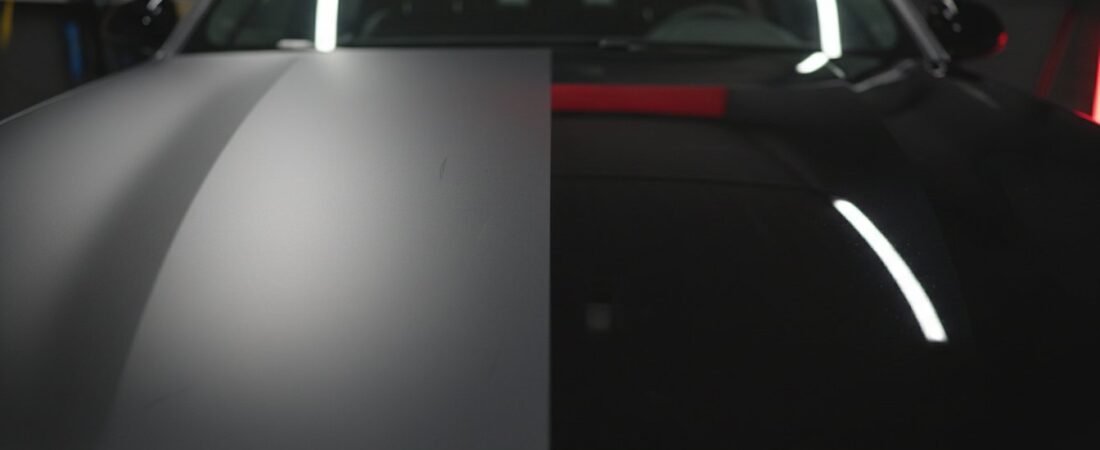
You washed it. You dried it properly. It’s genuinely clean. And it still looks flat, grey and tired.
That’s not dirt, and it’s not old paint. It’s a haze of damage so fine you can’t see the individual marks, and there’s a decent chance the tool you bought to fix it is what put it there.
I’m a certified master paint technician (B&P TEAM, 2019). Gloss is the thing I get paid for, and it has almost nothing to do with how clean a car is.
The short answer
A clean car that still looks dull usually has micro-marring, a haze of very fine damage from drying, clay or polishing that stopped a step early. One light finishing polish on a soft pad usually clears it. Then seal it.
What you need
Picks that fit this job.
Autoglym Rapid Ceramic Spray
Adds protection back after washing, claying or polishing.
Check on AmazonClay Bar (2 x 100g)
Removes bonded contamination a wash leaves behind. Use plenty of lubricant.
Check on AmazonI picked these on listing quality and have not tested them yet. Affiliate links: as an Amazon Associate I earn from qualifying purchases, at no extra cost to you.
Gloss Is Geometry
Gloss isn’t a substance. You can’t add it. It’s a geometric property of the surface.
- A perfectly flat clear coat reflects light in one direction. Every ray leaves at the matching angle. That’s a mirror, and your eye reads a sharp reflection as deep, wet, glossy.
- Roughen that surface microscopically and each ray still reflects, but the surface it hits is tilted slightly differently everywhere. The reflection scatters into a diffuse glow.
That’s dullness. It isn’t a missing layer of shine. It’s light being sprayed in every direction by a surface that’s no longer flat. And because the roughness is finer than your eye can resolve, you don’t see scratches. You just see grey.
What Micro-Marring Is (and Where It Comes From)
Micro-marring is the finest tier of damage, below swirls and below anything you’d call a scratch. Four sources:
- Drying. A towel that’s slightly too stiff, or used with pressure, leaves a uniform haze across an otherwise perfect panel.
- Clay. The one that surprises people. Clay shears bonded contamination off the surface, and a particle that doesn’t release cleanly gets dragged. Too aggressive a grade, not enough lubricant, or a bar you dropped and kept using, and you’ll mar the whole panel evenly while decontaminating it.
- Polishing that stopped a step early. A cutting compound always leaves its own fine haze. It’s meant to be refined out by a finishing step. Skip it and you’ve traded swirls for haze.
- Soft paint. Some manufacturers’ clear coats mar if you look at them wrong. Same technique, same products, different car, different result. That’s a material property, not a mistake.
Why It Matters
Marring is shallow, which is genuinely good news. It usually refines out with a light finishing polish and a soft pad, removing almost nothing.
The bad news is what people do instead. They see dullness, assume the paint needs “feeding,” and start layering wax. Wax on a rough surface fills a little and hides less than you’d hope, and now you have a maintenance habit built around a problem you never fixed. One correct step beats a lifetime of products aimed at the wrong cause.
The Fix
A light finishing polish on a soft pad, worked until the polish breaks down, then wiped off with a clean plush towel. You’re not cutting. You’re refining: flattening the very top of the surface until it reflects in one direction again. Most marring comes out in a single pass. Then seal it so the flat surface stays protected.
- Finishing pad: 5in Foam Pad Set (3-Pack)
- Finishing polish: a fine, low-cut polish
- Seal it after: Autoglym Rapid Ceramic Spray
Prevention Matters More
- Clay only what needs claying. Run the back of your hand, in a plastic bag, over the paint. Smooth means you don’t need clay. Claying smooth paint is all risk and no benefit.
- Drown the clay in lubricant. Far more than feels sensible. Use a fine grade. Fold it constantly so you always present a clean face. Drop it and it’s finished. Bin it.
- After a cutting step, always finish. A compound’s job ends with haze. The finishing step is half the process.
- Clay Bar (2 x 100g) · Car Clay Mitt
Three Habits That Create Marring While Trying to Prevent It
- Claying every wash. It’s a decontamination step, not a cleaning step. Twice a year is plenty for most daily drivers.
- Buffing dried wax off with a stiff towel. Wax should come off with almost no effort. If you’re working at it, you applied too much.
- Rubbing a smear with a dry cloth. Every dry rub on paint is a fine cut. Add lubrication or walk away.
The Test
Don’t look at your paint. Look at something straight reflected in it: a roof line, a doorway edge, a fence post. If the reflected edge is sharp, your surface is flat. If it’s soft and glowing, you have marring, and it’s the most satisfying thing in detailing to remove.
Quick FAQ
Why does my car look dull even when it’s clean? Gloss depends on surface flatness. Microscopic marring scatters light and reads as grey.
Can clay bar damage paint? Yes. Too aggressive a grade, too little lubricant, or a dropped bar can mar an entire panel.
Does wax fix a dull finish? Not really. It fills slightly but doesn’t flatten the surface. A light finishing polish does.
Watch: related video
A video from the Vehikolo channel on this topic. Voice and visuals are AI-generated.
Affiliate disclosure: Some links in this post are Amazon affiliate links. As an Amazon Associate I earn from qualifying purchases, at no extra cost to you. Prices on Amazon change, so check the current price there. I haven’t personally tested every product yet, and I’ll update this post with honest verdicts as I do.
Related posts: Swirl Marks · RIDS Deep Scratches · Holograms: The Buffer Trail of Shame · Haze After Polishing
Master guide: wash mitt vs sponge and the safe wash method