
Vehikolo Auto Works is reader-supported. If you buy through links on this page we may earn a commission at no extra cost to you. How we make money.
Not all scratches are the same, and treating them the same is how people ruin their own paint. One polishes out in two minutes. The other will still be there when you’ve removed so much clear coat the panel needs respraying. They look almost identical.
I’m a certified master paint technician (B&P TEAM, 2019), and here’s a hard truth: most of the panels I’ve had to respray for customers weren’t damaged in an accident. They were damaged by someone trying to fix a scratch.
The short answer
Try the fingernail and colour tests before you touch it. A scratch that catches your nail or shows a different colour is too deep to polish out. Leave it, fill it or touch it in, and measure paint thickness before you commit.
What you need
Picks that fit this job.
QUMOX Digital Coating Thickness Gauge
Shows how much paint you have before you polish.
Check on AmazonMagnetic Paint Thickness Tester
A simple paint thickness check before you polish.
Check on AmazonI picked these on listing quality and have not tested them yet. Affiliate links: as an Amazon Associate I earn from qualifying purchases, at no extra cost to you.
What a RIDS Is
RIDS stands for random isolated deep scratches. In the trade it’s the category everything gets sorted into once the swirls are accounted for.
- Swirls are shallow, dense and uniform: thousands of tiny cuts across a whole panel.
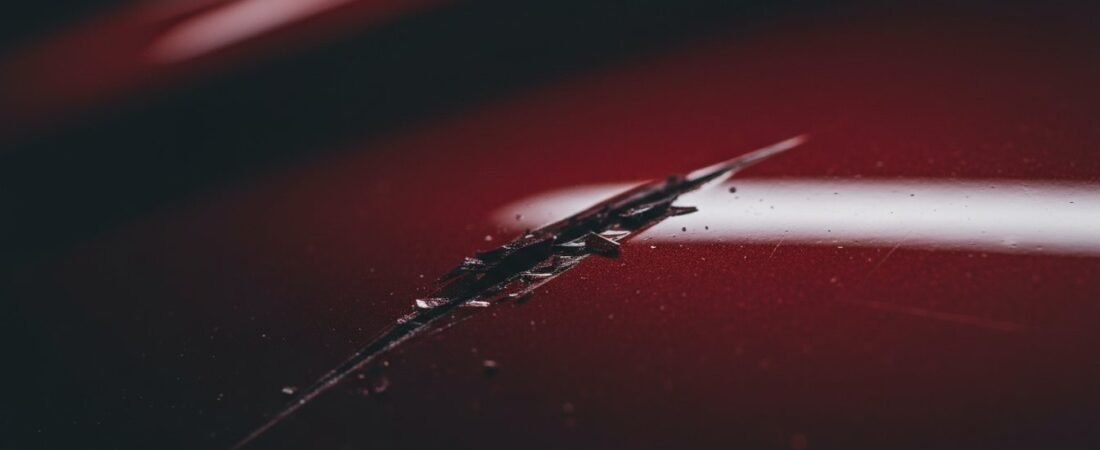
- A RIDS is the opposite: one scratch, on its own, deeper than everything around it. A key edge. A bag zip. A branch. A jet-wash lance dropped against the door.
Why Polishing Can’t Fix It
Polishing doesn’t fill a scratch, and it doesn’t heal one. It removes the clear coat around the scratch until the surface is level with the bottom of it.
A shallow scratch means lowering the surface slightly. A deep one means lowering the entire surrounding area a long way down. If the scratch is deeper than the clear coat you have to spare, you reach the colour coat before you reach the bottom of the scratch.
Two Tests, Thirty Seconds, No Equipment
1. The fingernail test. Run your nail gently across the scratch at 90 degrees.
- Nail glides: it’s likely within the clear coat, and polishing has a real chance.
- Nail catches on a distinct edge: it’s deep. Treat it as too deep.
It isn’t laboratory-precise. It’s a go/no-go gauge that errs on the side of your paint surviving, which is exactly what you want.
2. The colour test. Get a torch on it. If the scratch line shows white, grey, or a different colour to the paint, you’re looking through the clear coat at the primer or substrate. That isn’t a polishing job. That’s a filling job.
How to Remove Light Scratches From a Car
If your nail glides and the colour test comes up clean, you can often remove the scratch, or make it far less visible, at home. Wash and dry the panel first so you aren’t rubbing grit around. Work a fine polish or scratch remover over the area by hand or with a dual action polisher, then wipe it clean and check it under a torch. Stop once it’s gone or stops improving, because every pass removes clear coat you can’t get back. Then re-protect the panel with wax, sealant or a coating. If it’s still there after two or three light attempts, treat it as too deep and move to the options below.
The Predictable Failure
Someone polishes the panel. The swirls vanish and it looks incredible, except for one scratch that’s still there, and now it’s the only thing they can see. So they go back to it with a harder pad, more compound, more pressure, longer in one spot.
They’re no longer polishing a panel. They’re grinding a hole in one small area, and the edge of that hole is where the clear gets thinnest first. You’ll see it go slightly matte, or a faint colour change as the base starts showing through. By the time you notice, you’re past the point where more polishing helps, and the panel needs paint.
The cruel bit: it never had to happen. That scratch was always going to be one scratch on an otherwise perfect panel.
Your Four Options for a RIDS
- Leave it. Genuinely. Correct the swirls, accept the scratch, and the car looks 95% better. Nobody but you will ever find it.
- Fill it. A glaze or filling polish sits in the scratch and lowers its visibility without removing anything. It’s temporary (it washes out over weeks) but it’s honest, reversible, and costs no clear coat.
- Touch it in. If it goes through to primer, the only real repair is adding material. Clean it, fill it with matched paint in thin layers, let it sit proud, then level it later. That’s its own skill.
- A touch-up pen matched to your paint code
- Measure before you commit. A paint thickness gauge tells you what you actually have. If a panel reads noticeably thinner than the rest of the car, it’s been corrected or repainted before and has no margin left. Don’t polish it aggressively. Ever.
- Magnetic Paint Thickness Tester · QUMOX Digital Coating Thickness Gauge
Three Things I See Constantly
- Wet sanding a single scratch on the driveway. Sanding is a professional technique with real margins. On a home panel with no gauge, it’s a coin flip on a respray.
- Using a scratch-remover pen or compound on a scratch that shows primer. You’re abrading around a hole. It’ll look slightly better and be slightly deeper.
- Working one spot for more than a few passes. Heat builds, clear thins, and the panel gives almost no warning. If two passes haven’t changed it, stop. The scratch is telling you what it is.
The Point
Nail glides, you can try. Nail catches, you fill it, touch it in, or live with it, and living with it is a completely legitimate professional decision, not a failure.
Before you buy a machine polisher, do the nail test on every scratch you were planning to remove. You may find you need a bottle of glaze and an afternoon instead of a weekend and a respray.
Quick FAQ
Can you polish out a deep scratch? Only if it’s within the clear coat. If your fingernail catches in it, it’s too deep to polish safely.
Why did my scratch look worse after polishing? You may have thinned the area around it, or the scratch goes to primer and you’re abrading around a hole.
Does a fingernail test really work? It’s a rough go/no-go gauge, not a lab measurement, but it errs on the side of protecting your paint.
Affiliate disclosure: Some links in this post are Amazon affiliate links. As an Amazon Associate I earn from qualifying purchases, at no extra cost to you. Prices on Amazon change, so check the current price there. I haven’t personally tested every product yet, and I’ll update this post with honest verdicts as I do.
Related posts: Swirl Marks · Why Your Clean Car Still Looks Dull (It’s Not the Wax) · Holograms: The Buffer Trail of Shame
Master guide: the complete wash and polish guide