
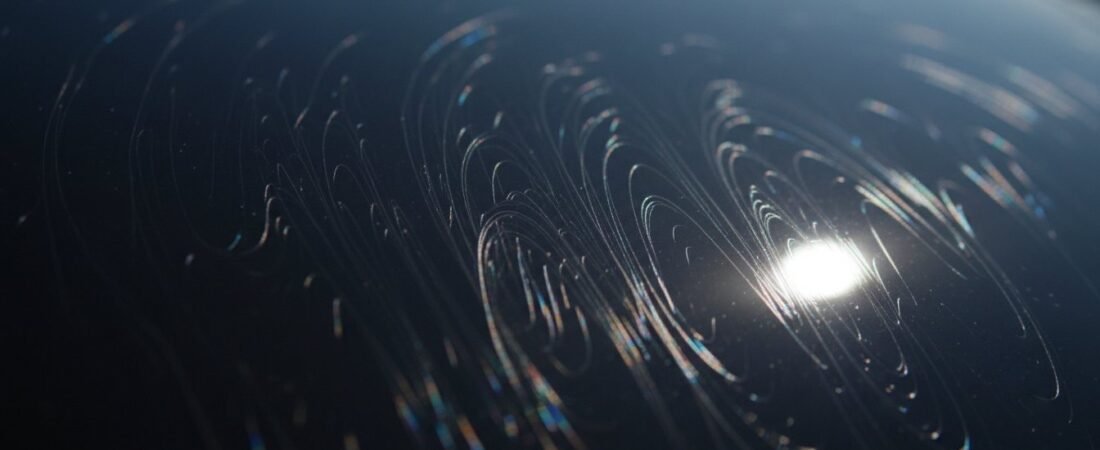
See those floating 3D ghosts running down the bonnet? They aren’t reflections. They aren’t the metallic flake. And they weren’t there before you paid someone.
That’s a hologram, also called a buffer trail. It means the job was started and not finished, and the strange part is that most people who leave them behind genuinely can’t see them.
I’m a certified master paint technician (B&P TEAM, 2019). I’ve inspected plenty of cars where the paint repair was excellent and the polishing afterwards undid it. And I’ll say up front: this isn’t a pile-on. It’s a fixable, understandable mistake.
The short answer
Holograms are a directional scratch pattern left by a rotary polisher, and they are hard to see indoors. Fix them with a soft finishing pad, light finishing polish and slow cross-hatched passes. Then inspect under a hard light and protect the paint.
What you need
Picks that fit this job.
500lm Handheld Paint Inspection Light
A bright light for spotting defects and checking hidden areas.
Check on AmazonI picked these on listing quality and have not tested them yet. Affiliate links: as an Amazon Associate I earn from qualifying purchases, at no extra cost to you.
What a Hologram Actually Is
A hologram is a directional scratch pattern. That’s the whole secret.
- Swirls are random, scratches pointing every which way, so under a point light they form a ring.
- Holograms are the opposite: thousands of fine scratches running roughly the same way, because a machine head moving in a consistent direction put them there.
When a huge population of scratches shares an orientation, they catch and release the light together as you move. Your brain reads that coordinated shimmer as depth, as something floating above or below the surface. Hence “hologram.”
The classic source is a rotary polisher. The head spins in one direction on one axis, so every abrasive particle travels the same arc. Work too fast, use too aggressive a pad, or stop before refining, and you’ve engraved a repeating pattern into the clear. Modern dual-action machines mostly avoid it because the head oscillates. Mostly. A DA in forced-rotation mode with a cutting pad and a heavy hand will do it too.
Why You Can’t See Them Indoors
Holograms are almost invisible under diffuse light. In a workshop with overhead fluorescents, or on an overcast day, the panel looks flawless. The light comes from everywhere, so no single set of scratches dominates. Roll it into direct sunlight, one hard point source at a low angle, and the pattern screams.
So the detailer isn’t necessarily cutting corners. They finished the job, inspected it under the light they had, and handed it over. The defect was invisible in the room where it was made. That’s why professional correction work is inspected under a hard, single-point light held at a low angle and rotated around the panel.
How Bad Is It?
Cosmetically annoying, physically shallow. Holograms live in the very top of the clear coat and usually refine out in one pass, removing very little.
The real cost is elsewhere. If your panel has holograms, it has already been cut once, and clear coat has already been spent on it. If it’s a repaired panel, that fresh paint may be thinner or softer than factory. The damage isn’t the shimmer. It’s that this panel’s correction budget just shrank for no benefit.
How to Fix Them
The same job that should have happened in the first place:
- Soft finishing pad, light finishing polish.
- Slow arm speed, low pressure, overlapping passes, cross-hatched: left to right, then up and down over the same area. You’re deliberately breaking up any consistent direction so no aligned pattern can form.
- Work the polish until it turns clear and breaks down, then wipe with a clean plush towel.
- Inspect immediately with a hard point light held low and swept around the panel from several angles. If a shimmer appears from one angle and not another, you’re not finished.
- Protect it, so you’re not back here in three months.
If a shop did this to your car, take it back, in sunlight, and show them. Most good shops will refine it on the spot. A shop that tells you it’s “the metallic” is telling you they can’t see it, and now you know why.
- Finishing pads: 5in Foam Pad Set (3-Pack)
- Finishing polish: a fine, low-cut polish
- Inspection: 500lm Handheld Paint Inspection Light
- If you’re going DA: a dual-action polisher. Learn paint thickness first.
Four Ways People Make Holograms Worse
- Correcting them with a cutting compound. You remove the old pattern and engrave a fresh, deeper one. Holograms are a finishing problem. Never bring cut to a finishing problem.
- Polishing in one direction only. Straight passes with no cross-hatch is how the pattern forms.
- A dirty or contaminated pad. Dried polish and clear residue turn a finishing pad into a cutting pad, gradually and silently. Clean it between panels and change it more often than feels necessary.
- Hiding them with a filler glaze before selling. It looks perfect for a wash or two, then the next owner finds them.
The Habit Worth Keeping
Whenever anyone hands your car back after paintwork or polishing, don’t inspect it in the workshop. Drive it into direct sunlight, stand at the end of the bonnet, and look down the panel at a low angle, before you pay.
Quick FAQ
What are holograms in car paint? Aligned scratches from a polishing machine that shimmer together in direct light.
Can holograms be removed? Yes, usually in one pass with a finishing polish and a soft pad, cross-hatched.
Why can’t I see them in the garage? Diffuse light hides them. Direct, low-angle point light reveals them.
Watch: related video
A video from the Vehikolo channel on this topic. Voice and visuals are AI-generated.
Affiliate disclosure: Some links in this post are Amazon affiliate links. As an Amazon Associate I earn from qualifying purchases, at no extra cost to you. Prices on Amazon change, so check the current price there. I haven’t personally tested every product yet, and I’ll update this post with honest verdicts as I do.
Related posts: RIDS Deep Scratches · Micro-Marring · Rotary Polisher Fails: How a Ten-Second Mistake Becomes a Respray · Haze After Polishing
Master guide: how to wash a car without scratching it