
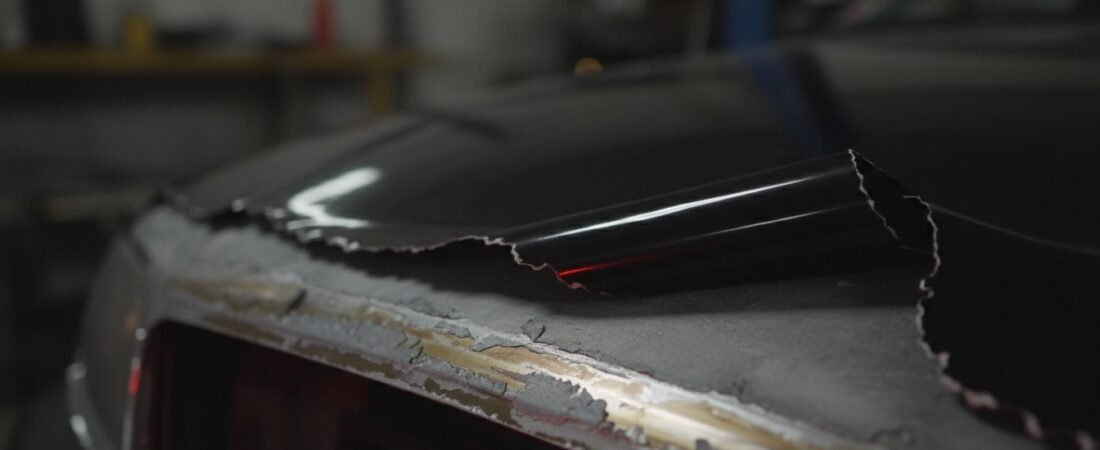
That’s not worn paint. Watch the edge: it’s standing proud of the panel around it, and it lifts. That’s delamination, a completely different thing from paint being worn, faded or degraded, even though from three metres away they look identical.
Here’s why the difference matters more than almost anything else: for one of those, the right answer is a product. For this one there is no product. There never was, and here’s exactly why.
I’m a certified master paint technician (B&P TEAM, 2019).
The short answer
Paint delamination means the layers of paint have stopped bonding to each other, so the paint lifts and peels, usually starting at a chip, scratch or panel edge. Polish, sealant and ceramic can’t stop it. The only real fix is removing the affected layers and refinishing the panel, or you can choose to live with it and stop working that area.
Your Paint Is a Stack
From the metal up: pretreatment, primer, colour coat (basecoat), clear coat. Roughly four layers, and each is bonded to the one below it. Not fused into one material, but bonded at an interface. So a paint system has surfaces you can see and interfaces you can’t, and they fail differently.
- A surface failure is degradation: the top layer breaking down in place, chalking, going matt, losing gloss. The material deteriorating while still attached.
- An interface failure is different: the layers are still good but have stopped holding on to each other. That’s delamination. It’s a mechanical problem, not a material one.
Why It Starts at an Edge
An intact bonded layer is held down across its whole area, and you’d have to break the bond everywhere at once to lift it. But give it one opening (a stone chip, a scratch through to primer, a panel edge or seam where the coating is thinnest, a previous repair boundary) and there’s an exposed edge of the interface.
Water and contamination get in at that edge. Temperature cycles expand and contract the layers at slightly different rates, working the separation. And a lifted flap catches (wind, wash water, a cloth) and each catch peels a little more. So the failure spreads from the opening and accelerates, because a bigger flap catches more. It’s why it looks like sunburn peeling: same mechanics.
Three Free Checks
- The edge, side on. Torch, low angle, along the surface at the patch boundary. Degraded clear coat fades into the good paint with a transition zone. Delamination has a step: the patch sits at a different height because a layer is missing. It’s the clearest indicator.
- The lift. Fingernail at the edge, gently. If it lifts, flexes, or you can get under it, the interface has let go. Degraded clear coat doesn’t lift. It’s still bonded, just ruined. Don’t peel it to find out, or you’ll turn a patch into a panel.
- The colour underneath. Exposed colour means the clear separated from the basecoat. Grey or a different colour means you’re down to primer and the basecoat has gone too. Metal is a different, more urgent conversation (corrosion).
Why You Can’t Stop It
Every product you can buy acts on the top of the stack. Polish removes a little clear. Wax and sealant sit on the clear. A ceramic coating bonds to the clear. The failure is underneath, at an interface below whatever you apply. You can put a beautiful, durable, expensive coating on a layer that isn’t attached to anything, and all you’ve done is make the thing that’s coming off shinier.
Worse, coating over a compromised area seals that area’s edge, so the water and contamination that got in have less chance of getting out. There’s a reasonable argument you’ve made it slightly worse, and no argument you’ve helped.
Nothing arrests delamination: not polish, sealant, ceramic or a “restorer.” The only thing that addresses a failed interface is removing everything above it and re-establishing it, which is preparation and refinishing. That’s a body shop, and on a roof or bonnet it’s usually a panel respray.
What You Actually Do
- Decide honestly whether you’re fixing it or living with it. On a fifteen-year-old car a roof respray can be a meaningful fraction of its value. “Living with it” is a respectable answer.
- If fixing it: a body shop, and get more than one opinion on scope. Ask whether adjacent panels are starting to go, because roof delamination often has company on the bonnet and boot lid (same sun, same age, same original process).
- If living with it: stop working that area. No polishing, no machine, no aggressive washing, nothing that catches the edge. Wash and dry gently.
There are no product links under this post because there’s nothing honest to link.
Quick FAQ
What is paint delamination? The paint layers separating from each other at their bonded interface.
How is delamination different from clear coat failure? Clear coat failure is the layer itself degrading. Delamination is the layers coming unstuck, and it shows a step at the edge that lifts.
Can delaminated paint be fixed? Only by removing the affected layers and refinishing the panel.
No product links in this post: nothing sold in a bottle fixes it, and I don’t link products I’d be guessing about.
Related posts: Clear Coat Failure · Fixing Chalky Red Paint: Oxidation Explained · Blistering: The Defect That Was Built In · Fisheyes in Car Paint
Master guide: wash mitt vs sponge and the safe wash method