
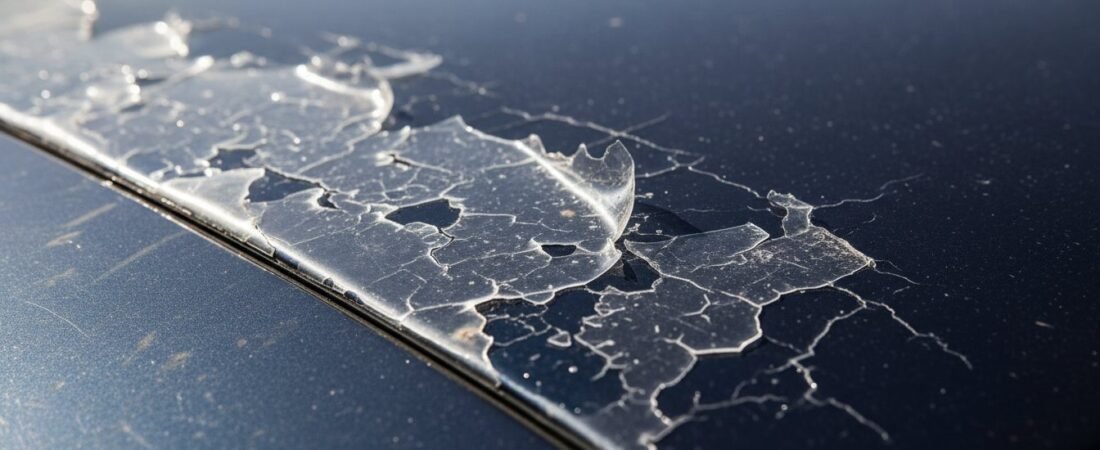
Once your paint looks like this, it’s over. Not “difficult.” Not “expensive but possible.” Over. There’s no polish, compound, wet sand, ceramic coating or wax that brings this back, and in the next few minutes I’ll explain why, so you can stop spending money looking for one.
I’m a certified master paint technician (B&P TEAM, 2019). I’ve had this conversation with many customers, and it’s the one where being straight matters most, because the alternative is watching them buy things that can’t help.
What Has Failed
Paint is layers: primer (adhesion and corrosion protection), a thin colour coat, and on top the clear coat, the only layer doing the protecting. Clear coat contains UV absorbers, sacrificial molecules that take the ultraviolet hit so the polymer around them doesn’t. They’re consumed and they don’t regenerate. Every sunny day spends some.
Once they’re depleted, UV breaks down the clear’s own polymer structure. First you lose gloss (the surface roughens). Then it goes cloudy and milky (degradation now through the depth). Then it cracks into a fine crazed pattern (embrittled film can’t flex). Finally it loses adhesion to the colour coat and lifts away in sheets. What’s failed isn’t the surface. It’s the layer itself, through its full thickness, and its bond to what’s beneath.
Why Every Product Fails
- Polishing removes the top of a layer to reveal sound material beneath. But when clear coat fails there is no sound material beneath. You remove failing clear to expose more failing clear, and make the remaining layer thinner, so it fails faster. It looks better for a week or two, then comes back worse.
- Coating over it is the same mistake with a longer delay. A coating bonds to the surface it’s applied to. If that surface is detaching from the car, your coating leaves with it.
The Four Stages
- Gloss loss and light hazing, uniform across sun-facing panels. The clear is still continuous. Polishing and a good UV-blocking sealant genuinely help, and it’s the last point at which you can slow it. Look at roof, bonnet and boot lid, not your doors. UV damage maps to sun exposure.
- Milky, cloudy patches that don’t clear when wet. Degradation is through the layer. Polishing buys appearance briefly and costs thickness. This is the point to stop polishing and start planning.
- Visible crazing like dried mud. The film is embrittled. Nothing reverses it. Cosmetic management from here.
- Lifting, flaking, defined peeling edges with colour exposed. Terminal, and it spreads, because each exposed edge lets moisture and UV attack the boundary. Tape test: press tape firmly on the edge of a suspect patch and pull. If flakes come away, that clear is already detached.
Your Four Honest Options
- Live with it. Genuinely. It’s cosmetic and doesn’t affect how the car drives, and the colour coat and primer still provide corrosion protection for a while. On an older car, doing nothing is a legitimate financial decision.
- Respray the affected panels, usually roof, bonnet and boot lid. It works properly and costs real money. Get quotes, since it varies enormously.
- Full respray. Rarely worth it on an older car, since it commonly exceeds the car’s value.
- Vinyl wrap, with one hard condition: wrap needs a stable surface. You can’t wrap over peeling clear (the film lifts and takes the wrap with it). Failing areas must be stripped and made sound first, so the cost is closer to painting than people expect.
What isn’t on the list is any bottle. That’s why there are no product links under this post. Safety: don’t polish or coat failing clear coat, and sanding a failing panel releases dust (PPE if attempted).
If Your Car Isn’t There Yet
UV absorbers are finite, and the only strategy is spending them slower:
- Shade. Garage, carport, or the other side of the street. Free, and the biggest factor.
- Keep it protected. A UV-resistant wax, sealant or coating is a sacrificial layer above your sacrificial layer.
- Watch the horizontal panels. Roof, bonnet and boot lid fail first, by years.
You’re not maintaining paint. You’re spending a finite resource. Look at your roof and boot lid tonight, not your doors. Catching it at the hazy stage is the only time any of this is cheap.
Quick FAQ
Can peeling clear coat be repaired without a respray? No. Polish, wax and coatings can’t restore a layer that has degraded through its thickness.
Why is my clear coat peeling on the roof but not the doors? Roofs, bonnets and boot lids get the most UV, so they fail first.
How much does it cost to fix peeling clear coat? It depends on panels and location. Get quotes, since resprays vary enormously.
No product links in this post: nothing sold in a bottle fixes it, and I don’t link products I’d be guessing about.
Related posts: Delamination: When the Layers Let Go · Fixing Chalky Red Paint: Oxidation Explained · Blistering: The Defect That Was Built In
Master guide: the complete wash and polish guide