
Listen to this guide (4 min)
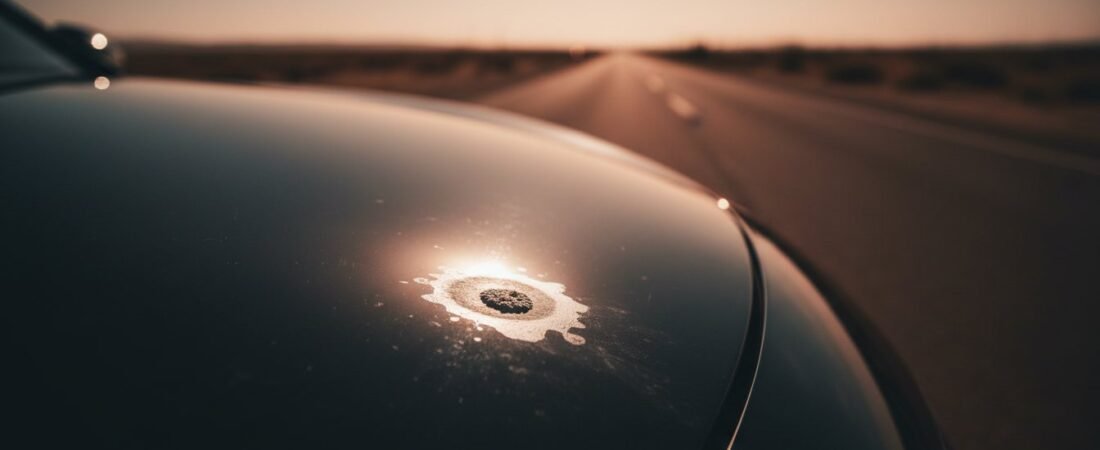
Everyone tells you bird droppings are acid. They’re not. When researchers measured them, they came out around pH 6, basically neutral. And yet this happens: a dull, rough crater that won’t wash off.
So if it isn’t acid burning your clear coat, what is? The real answer explains why the same dropping does nothing in winter and wrecks a panel in summer.
I’m a certified master paint technician (B&P TEAM, 2019). I’ve polished hundreds of these out, and I repeated the acid line myself for years until I read the research. So here’s the corrected version.
The short answer
Bird droppings are close to neutral, and the damage comes from enzymes that work faster in heat. Move the car into shade, lay a soaked microfibre over the dropping for two to three minutes, then lift it straight up. Repeat rather than scrub.
What you need
Picks that fit this job.
MR.SIGA Microfibre Towels (3-Pack)
A large microfibre for soaking, wiping and drying.
Check on AmazonAutoglym Rapid Ceramic Spray
Adds protection back after washing, claying or polishing.
Check on AmazonI picked these on listing quality and have not tested them yet. Affiliate links: as an Amazon Associate I earn from qualifying purchases, at no extra cost to you.
What’s Really Happening: Enzymes
Your clear coat is a chemically cross-linked network: long polymer chains tied together at thousands of points, like scaffolding. That cross-linking makes it hard, glossy and weather-resistant, and the links are specific chemical bonds (ether and ester linkages).
A bird dropping is digestive waste. It carries the enzymes an animal uses to break down food (amylase and lipase among them). Enzymes are catalysts, and their whole job is to cleave particular bonds, fast, at low temperatures, without being consumed. They’re evolved to attack the same types of bonds that hold your clear coat’s scaffolding together.
So the dropping doesn’t burn the surface. It digests it. Enzymes cut the cross-links, polymer fragments become soluble and lift away, and what’s left is a surface eaten unevenly. That’s the crater and the rough dull texture. It isn’t a stain sitting on your paint. It’s structure that’s been dismantled and removed.
Why Heat Is the Difference
Enzymes have a temperature curve. They get faster as things warm up, until they get too hot and denature. In the clear coat study, degradation climbed with temperature to around 60°C and then dropped off.
60°C is a dark bonnet on a hot sunny day. A dropping on a cold winter panel may do very little for a day. The identical dropping on a black bonnet in summer sits in the enzymes’ ideal working range and can etch visibly in hours. It was never random. It was the temperature.
Removal: Soak, Wait, Lift
The mistake everyone makes is wiping. A dried dropping contains grit, seed husks and mineral fragments, and wiping adds a field of scratches on top of an etch.
- Shade first. Move the car into shade before you start, even if it costs five minutes.
- Fold a plush microfibre into a pad, soak it with quick detailer or plain water, and lay it over the dropping.
- Don’t press, don’t rub. Leave it two to three minutes to rehydrate.
- Lift the towel straight up, taking the softened material with it. Fold to a clean face before going near paint again.
- Repeat rather than scrub. One more soak is always cheaper than one scratch.
- Finish with a light pass of quick detailer on a fresh towel.
Safety: droppings carry pathogens. Wear gloves if you have them, wash your hands, and the towel goes straight into the wash, not back in the boot.
- Plush microfibre: MR.SIGA Microfibre Towels (3-Pack)
It’s Gone but There’s a Mark. Can It Be Removed?
It depends how deep the digestion got.
- A faint dull patch or light ring usually polishes out. That’s the majority of cases caught within a day or two.
- A visible crater with a defined edge and rough base: run your fingernail across it. If it catches, levelling it means removing clear coat down to the crater’s base, usually more than you can spare.
- A colour change or a ring visible from standing height means it’s gone deep. That’s a refinishing conversation, not a polishing one.
Finishing polish for the light cases: a fine, low-cut polish.
Prevention Actually Works
A hard sealant or coating gives the enzymes a sacrificial layer to work on first. It buys you time, which on a hot day is the entire ball game.
Four Things That Turn a Dropping Into a Repair
- Dry-wiping it with whatever’s in the door pocket. The single most common way this ends badly.
- Scrubbing on a hot panel in direct sun. You’re working on softened clear with grit.
- Using a household or glass cleaner to “neutralise the acid.” There’s no acid to neutralise, and you may strip your protection.
- Leaving it because it rained. Rain rehydrates a dropping and puts the enzymes back to work. Wet is not clean.
The Habit
Keep a quick detailer and two folded microfibres in your boot. The difference between a two-minute clean and a paint correction is how fast you get to it.
Quick FAQ
Are bird droppings acidic? No. They measure around pH 6. The damage is caused by digestive enzymes.
How do you remove bird poop from a car without scratching? Soak a folded microfibre in quick detailer or water, lay it over the dropping for 2–3 minutes, then lift it off. Never wipe dry.
Can bird poop etching be polished out? A light etch usually can be. If your fingernail catches in the crater, it’s too deep to safely polish.
Affiliate disclosure: Some links in this post are Amazon affiliate links. As an Amazon Associate I earn from qualifying purchases, at no extra cost to you. Prices on Amazon change, so check the current price there. I haven’t personally tested every product yet, and I’ll update this post with honest verdicts as I do.
Related posts: Tree Sap on Your Car: Don’t Scrub That Sticky Blob · Bug Splatter on Your Bumper: Clean It the Day You Get Home · Road Tar: The Silent Paint Killer (and It’s Not the Tar)
Master guide: wash mitt vs sponge and the safe wash method