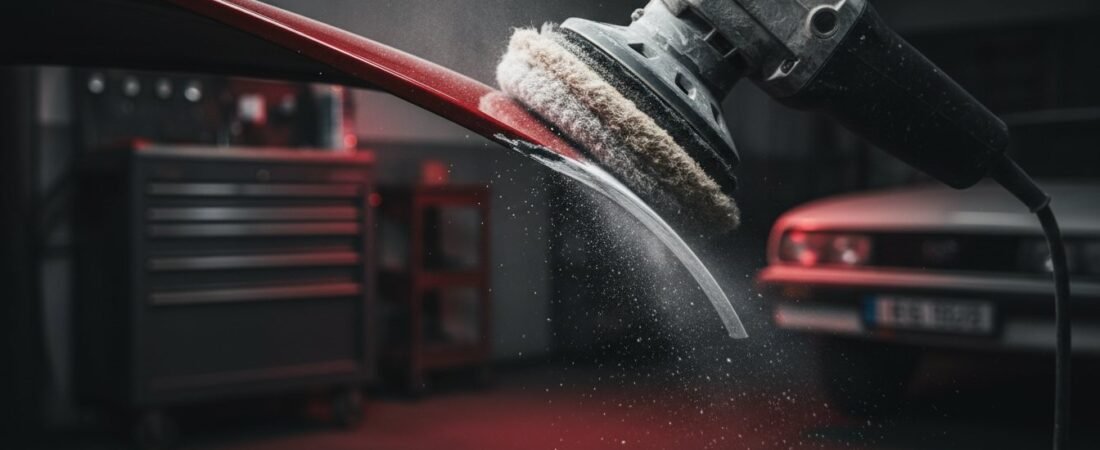
This is a rotary polisher. In the right hands it’s the fastest correction tool ever made. In the wrong hands it removes a panel’s paint in under ten seconds, and nothing you buy afterwards brings it back. No polish, no compound, no ceramic coating, no wet sand. There’s a paint booth, and an invoice.
I’m a certified master paint technician (B&P TEAM, 2019), and I use a rotary. I’m not here to tell you the tool is evil. I’m here to tell you exactly what it does when it goes wrong.
The short answer
Burnt paint comes from the pad cutting through the paint or from heat. It usually happens when the machine stops moving, at an edge, when the compound dries out or on a hot panel. If you are learning, use a dual-action and measure paint thickness first.
What you need
Picks that fit this job.
QUMOX Digital Coating Thickness Gauge
Shows how much paint you have before you polish.
Check on AmazonInfrared Thermometer Gun
Checks panel temperature between polishing passes.
Check on AmazonAutomotive Refinish Masking Tape
Protects edges and trim before you polish.
Check on AmazonI picked these on listing quality and have not tested them yet. Affiliate links: as an Amazon Associate I earn from qualifying purchases, at no extra cost to you.
“Burnt Paint” Is Two Different Failures
1. Strike-through (abrasive). You’ve mechanically removed all the clear coat in a spot and exposed the colour layer. On a solid colour you get a dull patch that won’t gloss up. On a metallic it’s worse: you lift the flake and get a faint, blotchy colour shift. That panel is finished.
2. Thermal (heat). Friction generates heat. A pad spinning under pressure on one spot puts a lot of energy into a small area very fast. Clear coat softens as it heats, then smears and distorts rather than cutting cleanly, and on thin or repaired paint it can lift or blister outright.
Strike-through is removal. Thermal is deformation. Most real disasters are both at once: heat softens the clear, and soft clear removes far faster than you expect.
Why a Rotary and Not a DA?
A rotary head spins on one axis, continuously, driven directly. It doesn’t stall and doesn’t slow when you press. That’s enormous cutting power available instantly, all concentrated wherever you happen to be holding it.
A dual-action oscillates and rotates loosely. Press too hard and it simply stops rotating: the machine protects you by failing to work. For a beginner, that stall is a safety feature. The rotary isn’t dangerous because it’s aggressive. It’s dangerous because it never tells you to stop.
The Four Conditions That Cause Nearly Every Burn
Remove any one and you usually escape.
- The machine stops moving. Every second in one spot is concentrated removal and heat. Keep a slow, steady arm speed. If you’re talking, the machine should be off.
- An edge or high point. Paint is thinnest where it curves (body lines, arch crowns, bonnet corners), and the pad loads pressure onto those points first. Thinnest paint plus highest pressure is where nearly all strike-throughs happen.
- The compound dries out. Abrasives in liquid cut in a controlled way. Once the liquid flashes off you have dry abrasive and hot foam against clear coat, and heat climbs fast. When it goes clear and light, stop and re-prime.
- A hot panel. A car in direct sun is already warm and the clear is already softened. Work in shade on a cool panel. Always.
The free check: after every pass, lay the back of your hand on the panel. Warm is fine. If it’s uncomfortable to hold there, you’re already past where you should be.
The Real Bill
A strike-through isn’t a spot repair. You can’t paint a patch in the middle of a panel and have it vanish. The repair has to be blended to a natural boundary, which usually means the whole panel, and on metallics often the adjacent panels so the flake matches. A ten-second mistake on a door becomes a door, a quarter and part of a roof. That’s why “I’ll just go a bit harder on this one spot” is the most expensive sentence in detailing. And on a lease or a car you’re selling, the respray shows on an inspection report.
What You Should Actually Own
- If you’re learning, a dual-action. Full stop. The stall that frustrates you is what keeps your paint on the car.
- A dual-action (DA) polisher
- A paint thickness gauge before more machine power. Knowing what you have beats cutting faster.
- QUMOX Digital Coating Thickness Gauge · Magnetic Paint Thickness Tester
- An infrared thermometer to check panel temperature between passes: Infrared Thermometer Gun
- Soft pads and finishing polish: 5in Foam Pad Set (3-Pack)
- Tape your edges. Automotive Refinish Masking Tape
And if you ever want to run a rotary, learn on a scrap panel from a wrecker. Not your own bonnet, and definitely not someone else’s car. (No, I’m not linking a wool pad.)
The One Habit
Keep it moving, tape your lines, work in shade, and put the back of your hand on the panel after every pass. That habit has saved more paint than any product I could link you.
Quick FAQ
What is burn-through when polishing? Removing so much clear coat that the colour layer shows, or heating the clear until it distorts.
Can you fix burnt paint? Not by polishing. It needs a respray, usually blended into neighbouring panels.
Is a rotary or DA better for beginners? A DA, because it stalls under too much pressure instead of cutting through.
Watch: related video
A video from the Vehikolo channel on this topic. Voice and visuals are AI-generated.
Affiliate disclosure: Some links in this post are Amazon affiliate links. As an Amazon Associate I earn from qualifying purchases, at no extra cost to you. Prices on Amazon change, so check the current price there. I haven’t personally tested every product yet, and I’ll update this post with honest verdicts as I do.
Related posts: Micro-Marring · Holograms · The Body Shop Secret Nobody Explains: Die-Back and Sand Scratch Swelling · Haze After Polishing
Master guide: the complete wash and polish guide