
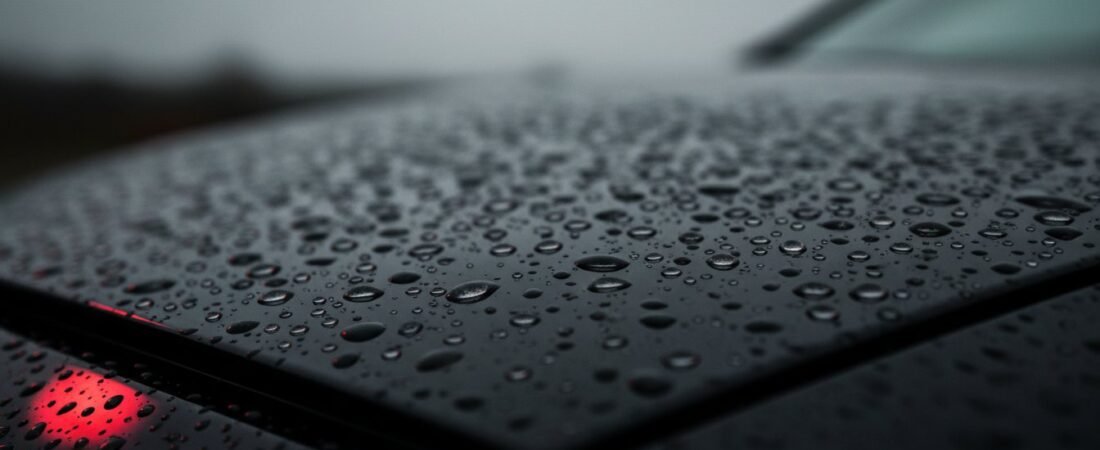
“Acid rain is eating your paint.” You’ve heard it, and there’s real evidence behind it: researchers have found elevated sulfate in the damaged areas of exposed test panels. But the rain landing on your car is not the dangerous part. Almost all the damage happens in the last few seconds of a droplet’s life, and once you know that, prevention becomes almost free.
I’m a certified master paint technician (B&P TEAM, 2019). I’d rather give you the version that holds up than the one that gets clicks, so this one has a correction built in.
The short answer
The damage mostly happens as droplets dry and concentrate, not when rain lands. Dry the car, protect the horizontal panels and use shade. For existing marks, wash and wet-test first: if a mark stays visible under water it is etched, and only a light polish can help.
What you need
Picks that fit this job.
XXL Twisted-Loop Drying Towel
A plush towel for drying without dragging.
Check on AmazonAutoglym Rapid Ceramic Spray
Adds protection back after washing, claying or polishing.
Check on AmazonI picked these on listing quality and have not tested them yet. Affiliate links: as an Amazon Associate I earn from qualifying purchases, at no extra cost to you.
What’s Actually Going On
Rainwater picks up dissolved pollutants (sulphur and nitrogen compounds from combustion) plus dust and salts. But when a droplet lands it’s extremely dilute: a huge volume of water and a tiny amount of dissolved material. At that concentration it does essentially nothing to a cured clear coat, which is engineered to survive weather.
Then the sun comes out. The water evaporates and the dissolved material doesn’t. The concentration climbs and climbs, and in the final moments the droplet is a microscopically thin film at many times its original strength. On a hot horizontal surface, that’s when it can attack the clear coat and leave a shallow crater the exact shape of the droplet. It’s the same mechanism as hard water spots. It isn’t the rain. It’s the drying.
The Pattern Is the Proof
Etching shows on horizontal panels (bonnet, roof, boot lid), rarely on doors. On a vertical panel the droplet runs off before it can concentrate. On a horizontal panel it sits where it landed, in full sun, and dries in place. Horizontal panels also get the most UV and heat.
And you don’t need rain at all. Dry acidic deposition settles as dust, dew forms overnight and dissolves it, and it dries off in the morning sun. A car under cover but exposed to the air can still get it. So if your bonnet is marked and your doors are clean, that’s the mechanism confirming itself.
The Honesty
- It isn’t universal. The research is explicit that it doesn’t affect all coatings or all vehicles. Coating chemistry, film build and how the car is kept all matter. Plenty of cars on the same street never show it.
- Most of it is shallow, in the top of the clear and removable with a light polish if caught reasonably early.
- What makes it serious is repetition over years on unprotected paint, thousands of dry-down cycles on a car that lives outside with nothing on the surface.
This isn’t a reason to panic. It’s a reason to own a drying towel and some sealant.
Prevention (Nearly Free)
- Don’t let water dry on the car. That’s the entire strategy. Dry it after a wash, wipe off rain when convenient, and don’t leave the car to bake after a shower.
- Protect the horizontal panels. Wax, sealant or coating gives the concentrating droplet something sacrificial to sit on. Bonnet, roof and boot lid take the damage.
- Shade matters twice: less heat during dry-down, and less UV.
Removal: The Water-Spot Ladder
- Wash first. A surprising share of “etching” is deposit sitting on top.
- Wet-test. Vanishes while wet and returns as it dries = deposit (chemistry removes it). Still visible under water = etch (no product fixes it).
- Light finishing polish, since it’s shallow. Start gentle, and don’t hunt the last one. Every etch you chase costs clear coat you can’t get back.
- 5in Foam Pad Set (3-Pack)
- Seal it. You’ve removed material from a panel that will be rained on again tonight.
Three Mistakes
- Reaching for a compound first. These marks are shallow.
- Buying a product to “neutralise acid rain.” By the time you can see the mark the reaction is finished. You’re polishing damage, not treating chemistry.
- Assuming a coating makes you immune. It buys you time. It doesn’t mean water can dry on the car indefinitely.
Try This
Compare your bonnet with your door in low sun. If one’s marked and the other isn’t, you’ve just confirmed the whole mechanism yourself.
Quick FAQ
Does acid rain damage car paint? The damage is real but happens as droplets evaporate and concentrate pollutants, not from the rain itself.
Why are my bonnet and roof etched but not my doors? Water runs off vertical panels. On horizontal ones it sits and dries in place.
Can acid rain etching be polished out? Usually, if it’s shallow. Wet-test first to make sure it’s an etch and not deposit.
Affiliate disclosure: Some links in this post are Amazon affiliate links. As an Amazon Associate I earn from qualifying purchases, at no extra cost to you. Prices on Amazon change, so check the current price there. I haven’t personally tested every product yet, and I’ll update this post with honest verdicts as I do.
Related posts: Hard Water Spots · Phantom Water Spots · Why Is My New Car Rusting?! (Iron Fallout Explained)
Master guide: the complete wash and polish guide