
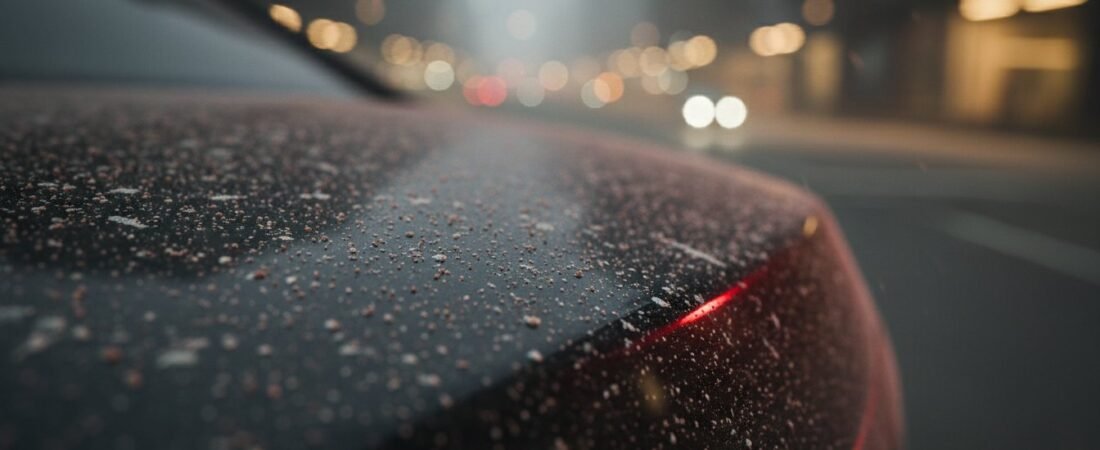
If you park in a city, near industry, or near building work, your paint is collecting things a wash won’t remove. People lump it all together as “pollution.” It’s four different contaminants: three merely annoying, and one you have days, not weeks, to deal with.
I’m a certified master paint technician (B&P TEAM, 2019). Fallout claims are a real part of the trade: cars parked in the wrong place on the wrong day.
The short answer
Fallout comes in four types: soot, iron, cement dust and paint overspray. Deal with cement dust first, because it is abrasive and alkaline when wet, so you have days rather than weeks. If a nearby business sprayed your car, take dated photos before you touch anything.
What you need
Picks that fit this job.
Foam Cannon Lance (Kärcher K5-K7)
Lays down pre-wash foam from a pressure washer.
Check on AmazonAutoglym Magma Iron Remover
Dissolves iron fallout without scrubbing. Check your finish first.
Check on AmazonClay Bar (2 x 100g)
Removes bonded contamination a wash leaves behind. Use plenty of lubricant.
Check on AmazonI picked these on listing quality and have not tested them yet. Affiliate links: as an Amazon Associate I earn from qualifying purchases, at no extra cost to you.
The Four Types
- Combustion soot. Fine carbon with oily condensables that bind it down. That’s traffic film. Alkaline pre-wash, then a normal wash.
- Ferrous fallout. Hot iron from rail, brakes and grinding, embedding and corroding. Iron remover (no contact), then clay.
- Cement and concrete dust. The underestimated one. It’s abrasive (ground mineral, so dry wiping drags rock across your clear) and alkaline when wet. Add rain or dew and you have a strongly alkaline solution curing on your paint, which can etch and bond hard. The instinct to brush it off dry is exactly wrong, and so is leaving it in the rain.
- Paint overspray. Fine airborne droplets that land, cure, and leave thousands of tiny hard specks. The paint feels like fine sandpaper.
Which One Do You Have? Two Minutes
The bag test: a hand inside a thin plastic bag, run lightly over roof and bonnet. The bag amplifies texture your fingers can’t feel. Smooth means it’s film and washing is the answer. Gritty means bonded particles and no shampoo will fix it.
Then look at colour and pattern:
- Grey-brown, uniform, worst on the rear and lower half, slightly greasy: traffic film.
- Orange specks, obvious on light paint: ferrous fallout.
- Grey, dusty, sitting on top, worst on horizontal panels, appearing within days of building work nearby: cement dust.
- Uniform fine roughness across everything including the glass: overspray. Glass is the tell: contamination on your windows as well as paint arrived as airborne droplets.
Cement Dust First (It’s Time-Critical)
- Do not dry-wipe, brush or dust it. Dry contact is sanding.
- Flood it off with plenty of water at low pressure, top down, keeping the water moving so it’s carried away in volume. Do the whole car: glass, arches, shuts.
- Wash normally with lots of lubrication, minimal pressure, changing your mitt water often.
- Bag-test again. Anything still bonded needs clay with heavy lubricant and light pressure.
- Check for etching with the wet test. Vanishes while wet = deposit. Still visible under water = the surface has been attacked (polishing).
- Protect it. You’ve stripped the panel and the building site hasn’t gone anywhere. If you’re parked beside ongoing work: a cover, a different spot, or a maintained coating.
Overspray (Document First)
If a nearby business sprayed your car, that’s potentially a claim. Photographs and dates taken before you touch anything are worth more than anything you can do with a clay bar. Removal can complicate a claim, so ask before you start.
For light overspray, clay is the usual route, with heavy lubricant, light pressure and constantly fresh clay faces (you’re shearing thousands of hard specks off). Expect marring afterwards: it’s clay, then a light finishing polish, then protection. Heavy overspray isn’t a DIY job. Overspray on textured trim and rubber is hard to remove without damaging it, and that’s often what makes these claims expensive.
- Pre-wash lance: Foam Cannon Lance (Kärcher K5-K7) · 2L Hand-Pump Foam Sprayer
- Iron: Autoglym Magma Iron Remover
- Clay: Clay Bar (2 x 100g) · Car Clay Mitt
- Protect: Autoglym Rapid Ceramic Spray
- (No product for overspray. See above.)
Four Mistakes
- Dry-brushing dust off a car, especially cement. The most damaging habit here.
- Treating everything as “dirt” and washing harder. Three of the four don’t respond to washing, and pressure on bonded particles just marks the paint.
- Claying before chemical decontamination. Chemistry first, then clay.
- Touching overspray before photographing it and asking about a claim.
Do the bag test on your roof and your bonnet. If it’s gritty, washing was never going to be the answer.
Quick FAQ
How do I remove cement dust from a car? Flood it off with lots of low-pressure water first. Never dry wipe it, then wash and bag-test.
What is overspray on a car? Airborne paint droplets that land and cure as tiny hard specks. Clay removes light cases, but heavy overspray needs a specialist.
How can I tell if my paint has bonded fallout? Do the bag test. Gritty means bonded contamination.
Affiliate disclosure: Some links in this post are Amazon affiliate links. As an Amazon Associate I earn from qualifying purchases, at no extra cost to you. Prices on Amazon change, so check the current price there. I haven’t personally tested every product yet, and I’ll update this post with honest verdicts as I do.
Related posts: Hard Water Spots · Phantom Water Spots · Acid Rain Etching · Iron Fallout
Master guide: how to wash a car without scratching it