
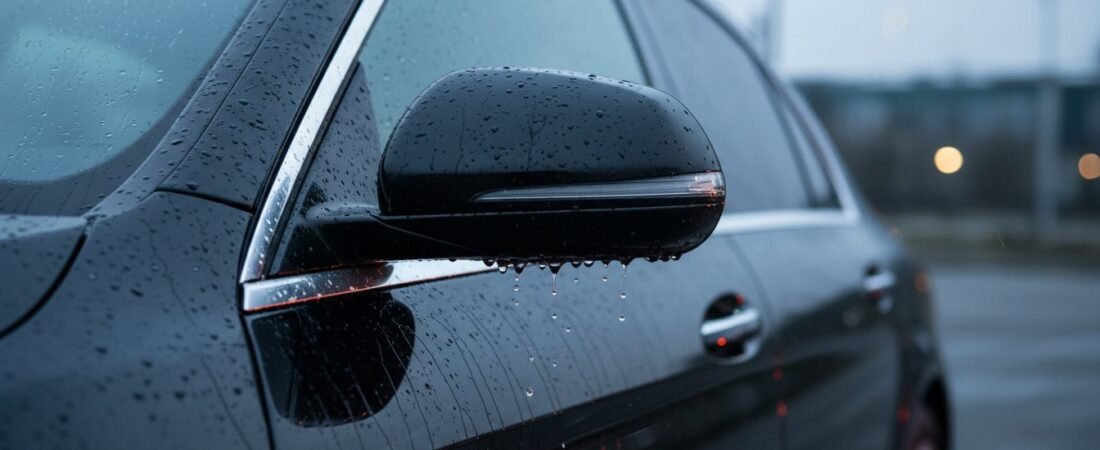
You finished the car last night. Washed, dried properly, polished, sealed. It was perfect. This morning there are streaks running from every badge, mirror and panel gap. No rain. No sprinkler.
And your sealant didn’t fail. Your car is still draining, hours after you put the towels away.
I’m a certified master paint technician (B&P TEAM, 2019). This used to catch me out on handovers: a car signed off spotless, and the customer photographs it next morning covered in trails.
The short answer
Water spots that come back after washing are usually water still draining from badges, mirrors and panel gaps. Rinse and blow out those traps before you dry the paint. Wait 15 to 20 minutes, wipe any fresh trails, and only then protect the car.
What you need
Picks that fit this job.
High-Pressure Air Blow Gun
Blows water or debris out of tight spots. Needs a compressor.
Check on AmazonXXL Twisted-Loop Drying Towel
A plush towel for drying without dragging.
Check on AmazonI picked these on listing quality and have not tested them yet. Affiliate links: as an Amazon Associate I earn from qualifying purchases, at no extra cost to you.
Where Water Hides
A car body isn’t a smooth shell. It’s full of places water enters easily and leaves slowly:
- Badge and emblem edges (water wicks under the lip by capillary action)
- Mirror housings (hollow, full of ledges)
- Panel gaps, shut lines and seams: bonnet edges, boot lids, door shuts, fuel flaps
- Grilles, trim joints, roof rails, aerial bases, wheel nuts and arch liners
Why It Comes Back Worse
That water has been sitting in a cavity in contact with road film, dust, salts and old product residue. It isn’t clean anymore. It’s a concentrated solution. It emerges onto a warm, dry, freshly protected panel, runs a short way, and evaporates in place, the same mechanism as normal water spotting: the water leaves and everything dissolved stays.
So it isn’t a spot that “came back.” It’s a fresh deposit from dirtier water, delivered after you’d finished.
There’s a version that bites people doing everything right. Polishing uses water-based products right up against those same seams, and the pad drives spray and residue into gaps. That residue is abrasives, oils and polymers, and when it weeps back out it dries into a stubborn, slightly hazy trail exactly where you did the most work. Seal over it and the trail appears on top of fresh protection, which is why it looks like the coating failed on day one. It didn’t. You may even have sealed a damp seam.
The Fix Is Sequence, Not a Product
- Flush the traps before you dry. Open doors, boot and fuel flap and rinse into the shuts, behind badges, around mirror bases, grilles and arch liners. Get the dirty trapped water out while you’re holding a hose.
- Blow them out. A blower, car dryer or filtered compressed air at a sensible distance: badges, mirrors, shuts, grille, wheel nuts, aerial base. This removes almost all of it.
- Then dry the paint. Not before, or you dry it twice.
- Let it dwell 15–20 minutes before protecting, ideally somewhere warm. Come back, and you’ll find fresh trails. Wipe those with a drying aid or quick detailer and a clean towel. Now the car is dry.
- Then wax, seal or coat. Protecting a car that’s still weeping is the most common cause of “day one failure.”
If you’re correcting paint, add: panel wipe the edges and shuts after polishing and before protecting.
- Blow-out: High-Pressure Air Blow Gun (needs a compressor)
- Towels: XXL Twisted-Loop Drying Towel
Safety: keep compressed air at a sensible distance from seals and trim edges, and don’t chase spots with a polisher on freshly coated paint.
Already Got Trails?
- Most are fresh surface deposit, so a wash or quick detailer and a plush towel removes them.
- If they resist, wet-test them. Vanish while wet means deposit. Still visible under water means etched (see the hard water spots ladder).
- Don’t reach for a polisher first. On freshly sealed paint you’d be removing protection to chase a mark a towel would have taken off.
If it keeps happening in the same three places, that’s your car telling you exactly which traps to flush.
Three Mistakes
- Sealing straight after drying with no dwell. The big one.
- High-pressure air held right against seals and trim edges. You’re evacuating water, not testing the seals.
- Blaming the product. A sealant that “failed overnight” almost never did. If you strip and re-apply without changing sequence, you’ll get the same result.
After your next wash, come back two hours later and look at the badges and mirrors. What you find is what’s been ruining your mornings.
Quick FAQ
Why do water spots appear the next day? Water trapped in badges, mirrors and gaps drains out later, carrying dissolved dirt, and dries in place.
Did my sealant fail? Almost certainly not. The trail emerged after you applied it.
How do I stop overnight streaks? Flush and blow out the traps, dry the paint, wait 15–20 minutes, wipe what appears, then protect.
Affiliate disclosure: Some links in this post are Amazon affiliate links. As an Amazon Associate I earn from qualifying purchases, at no extra cost to you. Prices on Amazon change, so check the current price there. I haven’t personally tested every product yet, and I’ll update this post with honest verdicts as I do.
Related posts: Traffic Film · Hard Water Spots · Is Rain Damaging Your Paint? Not How You Think
Master guide: how to wash a car without scratching it