
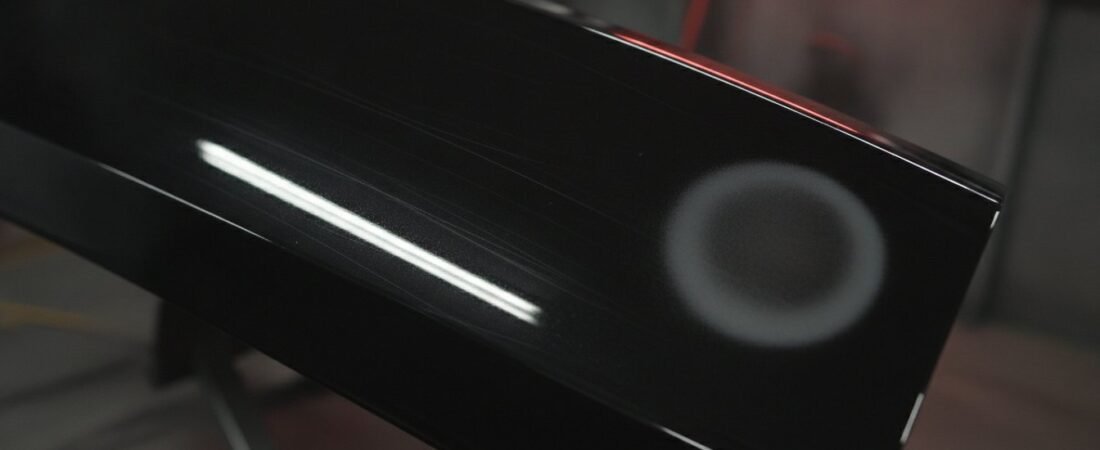
Your repair looked flawless at pickup. Three weeks later it’s gone slightly flat, and at the right angle you can see faint straight lines under the gloss that definitely weren’t there before.
You weren’t ripped off, probably. What you’re watching is the paint finishing a job it hadn’t finished when they handed you the keys. And two completely different things can be happening.
I’m a certified master paint technician (B&P TEAM, 2019). I’ve caused both of these defects early on and had to explain them to customers. So here’s the honest version.
The short answer
Even flatness a few weeks after a repair is usually die-back, which is normal curing. Straight, directional lines are usually sand scratch swelling, a prep defect. Don’t polish it yourself in the first weeks. Wait out the cure, look again, and go back to the shop if the lines remain.
Defect 1: Die-Back (Normal Curing)
Paint goes on as solids carried in solvent. The solvent keeps everything liquid long enough to flow out flat, then it has to leave. Most leaves in the booth, which is why the panel looks incredible at pickup. But solvent release doesn’t stop at the door. It continues for days and, more slowly, weeks.
As solvent leaves, the film loses volume and shrinks, pulling the surface down slightly wherever there’s something beneath to pull against. The mirror-flat surface becomes microscopically uneven, and an uneven surface scatters light. Gloss drops. That’s die-back. Not a rip-off, not a bad product. Solvent leaving a film that wasn’t fully cured at delivery.
Defect 2: Sand Scratch Swelling (A Prep Defect)
Before spraying, the surface is sanded so paint can grip, which leaves fine scratches. Sanded at the right grade, the paint film fills those scratches completely and you never see them. But if the sanding was too coarse for what went over it (a primer-grade finish with colour straight over), the scratches are deeper than the film can cover.
Fresh solvent softens and swells the filler or primer in each scratch. For a while that masks everything. Then the solvent leaves, the swollen material contracts, and the scratch pattern telegraphs up through the new paint. The paint didn’t scratch. The scratch was always there.
Which One Do You Have?
| Die-back | Sand scratch swelling | |
|---|---|---|
| Pattern | Uniform. The whole repaired area drops in gloss evenly | Directional. Straight parallel lines, all one way |
| Where | Whole repair | Stops dead at the blend edge |
| Fix | Usually polishes back once cured, often better than before | Doesn’t polish out (it’s under the paint). The shop must flat and recoat |
| Cause | Normal curing | Preparation defect |
You can tell them apart from three metres away.
What to Do as the Owner, in Order
- Don’t seal it too early. Fresh paint is still releasing solvent. Sealant or coating too soon can trap it. Wash gently with a pH-neutral shampoo and hold off on protection until the shop says it’s cured (usually weeks, not days).
- Don’t polish it yourself in the first weeks. Soft, uncured paint mars easily and removes unpredictably. You’d be correcting a surface that’s still moving.
- Wait out the cure, then look again. A lot of die-back resolves or becomes trivially polishable once the film stabilises.
- Go back to the shop. Politely, in daylight, and show them. Most good shops expect this conversation. If it’s sanding lines, that’s a redo, and a reputable shop will treat it as one.
Three Things That Turn a Fixable Problem Into a Bad One
- Ceramic coating a fresh repair the week you get it home. You’ve sealed a film that still needs to breathe.
- Attacking the lines with compound. You won’t reach the scratches (they’re beneath the paint) but you will thin the fresh, soft clear covering them.
- Waiting eighteen months to say anything. Every shop has a workmanship window. Raise it early, in writing.
The One Question to Ask Your Shop
“What grade did you finish sanding at before colour?” A shop that answers immediately and specifically thinks about this. One that gets vague has told you something too.
An optional tool for inspecting a repair in raking light: 500lm Handheld Paint Inspection Light. There’s no product that fixes either of these defects, which is why this is a trust post and not a shopping post.
Quick FAQ
Why did my new paint job go dull? Solvent is still leaving the film and shrinking it, so gloss drops. It’s called die-back and usually polishes out once fully cured.
Why are sanding lines showing in my new paint? The surface was sanded too coarse for the coating, and the scratches swelled and later contracted. That needs a recoat.
When can I wax or ceramic coat new paint? Only when your shop confirms it has cured, typically weeks after the repair.
Affiliate disclosure: Some links in this post are Amazon affiliate links. As an Amazon Associate I earn from qualifying purchases, at no extra cost to you. Prices on Amazon change, so check the current price there. I haven’t personally tested every product yet, and I’ll update this post with honest verdicts as I do.
Related posts: Holograms · Burn-Through · Don’t Polish the Edges: Why Body Lines Burn Through First
Master guide: wash mitt vs sponge and the safe wash method