
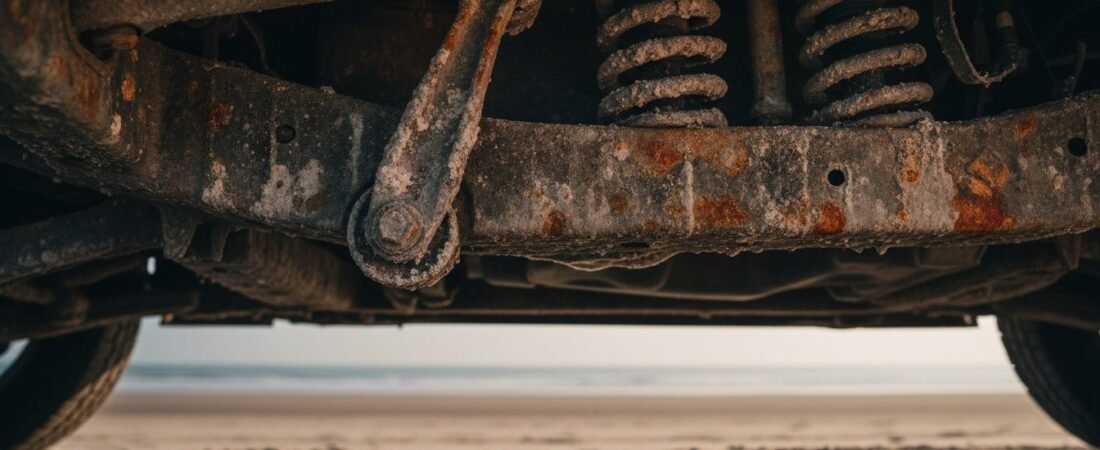
A car can look immaculate on top while the underside is being eaten away. And if you live near the coast, or anywhere that salts roads in winter, the thing doing it isn’t water. Water alone is remarkably slow at rusting a modern car. Add salt and the chemistry changes entirely.
I’m a certified master paint technician (B&P TEAM, 2019). Paint and corrosion are the same subject from two sides: my job has always been keeping steel away from the atmosphere, and rust is what happens when that fails.

The short answer
Salt makes water conductive and pulls moisture from the air, so corrosion keeps going. If you live near the coast, rinse the underside regularly, keep drain holes clear and inspect sills and arches with a torch every few months. Never work under a car unless it is properly supported.
What Salt Actually Does
Rusting is electrochemical. It needs iron, oxygen and an electrolyte: a liquid that conducts. Pure water is a poor conductor, so bare steel in clean water rusts, but slowly.
- Salt dissolves into ions, making the water conductive. The tiny currents that drive corrosion suddenly flow easily, and the process accelerates dramatically.
- Salt is hygroscopic: it pulls moisture out of the air. Salt deposits inside sills and chassis rails don’t need rain. On a humid night they draw water to themselves and create their own electrolyte, in the dark, against bare metal. That’s why coastal cars rot in places that never get wet from outside, and why winter road salt keeps working long after the snow’s gone.
Salt makes water conductive, and it brings its own water.
Five Places Corrosion Starts (on Every Vehicle)
Corrosion isn’t random. It starts where salt collects and can’t leave.
- Drain holes. Doors, sills and tailgates have drain holes so water can get out. Block one with mud and road film and you’ve built a reservoir. The single highest-value check, and it costs nothing.
- Seams and spot welds. A capillary gap where salt solution wicks in and sits, and is hard to rinse out.
- Box sections and cavities: sills, chassis rails, pillars. Enclosed, unventilated, and coated inside from the factory, but that coating is decades old on an older car.
- Anywhere the underbody coating is damaged: stone chips, jacking points, speed-bump scrapes. Corrosion concentrates at a break in the coating.
- Suspension, brake and exhaust hardware: bolts, pins, brackets, often bare or lightly coated, where seizing becomes a real cost.
Go and Look (Safely)
A torch, on a dry day, on level ground. You do not need to get under the car on a jack to see the sills, arch lips, drain holes and visible chassis rails. Never work under a vehicle supported only by a jack.
- Surface rust: a thin orange film on otherwise sound metal. Very common, largely cosmetic, manageable.
- Scale: thicker, flaking, layered. The metal has lost material and needs attention.
- Structural corrosion: perforation, metal that gives when pressed, or rot in a load-bearing area (sills, chassis rails, mounting points, subframes). That’s a safety matter and a professional assessment, not a YouTube one.
The honest limit: you can’t tell from the outside. Corrosion works from inside a cavity outward, so what’s visible is the late stage of something that started where you can’t see it. A clean-looking sill can be paper thin behind its coating. Use your inspection to decide whether to get it looked at, not to conclude it’s fine.
What Returns Most for the Effort
- Rinse the underside regularly, especially after beach driving or salted roads.
- Keep drain holes clear.
- Protect exposed areas, where appropriate, with lanolin or cavity wax.
- Inspect sills, drain holes and arches with a torch every few months.
Restrained recommendation: whether rust proofing is worth it depends on your car’s age and condition. Ask a specialist before spending real money.
A simple routine
- Rinse the underside and wheel arches after every beach or salt-road trip.
- Keep drain holes in doors and sills clear.
- Touch up stone chips and scratches before they spread.
- Book a yearly underbody look, especially for an older car.
None of this needs special equipment, and it is far cheaper than repairing corroded panels or brackets later.
Quick FAQ
Why is salt worse than water for rust? It makes water conductive and it’s hygroscopic, so it keeps drawing moisture from the air.
Where does undercarriage rust start? Drain holes, seams, box sections, damaged underbody coating, and suspension and brake hardware.
Can I tell if rust is structural from the outside? No. Corrosion starts inside cavities, so a clean surface doesn’t guarantee sound metal.
Affiliate disclosure: Some links in this post are Amazon affiliate links. As an Amazon Associate I earn from qualifying purchases, at no extra cost to you. Prices on Amazon change, so check the current price there. I haven’t personally tested every product yet, and I’ll update this post with honest verdicts as I do.
Related posts: Electrolytic Corrosion: Your Car Becomes a Battery · Caliper Seizing in Salt Air: Brakes Have to Move · Clearcoat Chalking: Run a Damp Towel Across the Panel
Master guide: the complete wash and polish guide