
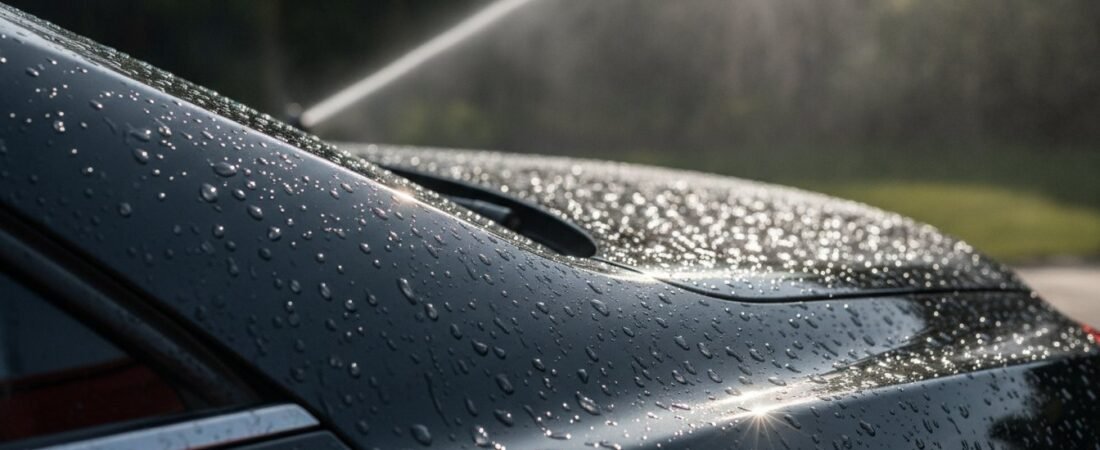
Your neighbour’s sprinkler is spraying liquid rock onto your car. Every morning, while you sleep. That’s not a joke. Water from a bore, tap or sprinkler carries dissolved minerals, and when the water evaporates, the minerals don’t. They stay, concentrate, and on a hot panel stop sitting on your paint and start etching into it.
I’m a certified master paint technician (B&P TEAM, 2019). Water spotting is the defect people most often assume is permanent when it isn’t, and most often assume is trivial when it’s already too late.
The short answer
Water spots start as mineral deposits and can etch into the paint. Work up from gentle: wash and clay, then an acidic water-spot remover, then a machine polish for etching. The best prevention is drying the car quickly and keeping it away from sprinklers.
What you need
Picks that fit this job.
Clay Bar (2 x 100g)
Removes bonded contamination a wash leaves behind. Use plenty of lubricant.
Check on AmazonXXL Twisted-Loop Drying Towel
A plush towel for drying without dragging.
Check on AmazonAutoglym Rapid Ceramic Spray
Adds protection back after washing, claying or polishing.
Check on AmazonI picked these on listing quality and have not tested them yet. Affiliate links: as an Amazon Associate I earn from qualifying purchases, at no extra cost to you.
How a Spot Forms
A droplet contains dissolved minerals (mainly calcium and magnesium, and in some regions silica). As it evaporates, the droplet shrinks and minerals concentrate. It dries from the outside in, so most of the mineral collects at the perimeter, which is why you get a ring, not a dot.
So far, a harmless deposit. Then: that concentrated solution on a sun-heated panel is alkaline chemistry in prolonged contact with your clear coat at elevated temperature. Given enough time, heat and concentration, it etches, leaving a crater the exact shape of the droplet. The deposit is temporary. The etch is permanent.
Three Severities
- Surface deposit. Mineral sitting on the clear. Comes off with a dedicated acidic water-spot remover (acid dissolves mineral carbonates), or in mild cases a strong wash and clay.
- Etched. A shallow crater. No chemical fixes it, because the mineral’s gone and what’s left is missing clear coat. That’s a polishing job.
- Deep-etched or silica-bonded. Long-term, repeated (usually bore water or years of sprinkler exposure). Craters you can feel, or bonded silica behaving more like glass. Sometimes correctable, often not, and on glass it can be permanent.
The Two-Minute Test
- Wet it. Spray water over the area. If spots vanish while wet and return as it dries, it’s mostly deposit. Still visible under water means the surface itself is damaged: an etch.
- Fingernail. If you can feel an edge, you’re in type-three territory.
The Ladder (Cheapest and Gentlest First)
- Wash and clay. Free or cheap; clears light deposit.
- Acidic water-spot remover. Cool panel, shade, short dwell, rinse thoroughly. Never on unsealed or polished alloys, never left to dry. Follow the bottle’s timing, not your instincts.
- Machine polish for etching. Light finishing polish first, and only step up if it doesn’t move. Every etch you chase costs clear coat.
- Accept it. For deep craters or etched glass, the honest answer is often that correction costs more than the cosmetic benefit. That’s a legitimate stopping point.
Then re-protect, because all of these strip.
- Clay: Clay Bar (2 x 100g) · Car Clay Mitt
- Polish: 5in Foam Pad Set (3-Pack)
- Glass spots: Car Glass Polish Coating Kit
- Re-protect: Autoglym Rapid Ceramic Spray
Safety: acidic removers need PPE, dwell limits, no sun, no unsealed alloys, and not on fresh paint.
Buying a water spot remover? Choose one made for cars, and check the label for the surfaces it’s safe on. Most are acidic, so the rules above apply to all of them.
Prevention: Damage Needs Three Things
Minerals, heat and time. Remove any one and you win.
- Remove the time. Dry the car immediately and completely. A spot that never dries on the paint never becomes anything. The highest-value habit here.
- XXL Twisted-Loop Drying Towel
- Remove the heat. Never wash in direct sun or on a hot panel.
- Remove the minerals. An inline deionising filter on your final rinse gives mineral-free water you can air-dry with no spotting.
- Move the car. If a sprinkler hits it every morning, no product will out-run it. Change where you park or the sprinkler’s arc. The fix nobody wants and the only permanent one.
Three to Avoid
- Household vinegar or descaler on paint. Uncontrolled acidity with no inhibitors, and it’ll mark trim and alloys on the way past.
- Compounding hard at spots that are still just deposit. You remove clear coat to solve a problem chemistry would have solved free.
- Letting an acidic remover dry or overstay. You’ve swapped a mineral problem for a chemical one.
Find out whether your water is hard before you buy a single product. It changes every decision here.
Quick FAQ
Are water spots permanent? Deposits aren’t. Etches need polishing, and deep etches may be permanent.
How do I tell a deposit from an etch? Wet the area. If the spots disappear while wet, it’s deposit. If still visible, it’s etched.
Is vinegar safe for water spots on paint? Avoid it. It’s uncontrolled acid with no corrosion inhibitors.
Affiliate disclosure: Some links in this post are Amazon affiliate links. As an Amazon Associate I earn from qualifying purchases, at no extra cost to you. Prices on Amazon change, so check the current price there. I haven’t personally tested every product yet, and I’ll update this post with honest verdicts as I do.
Related posts: Road Tar · Traffic Film · The Spots Came Back Overnight: Your Car Is Still Draining
Master guide: wash mitt vs sponge and the safe wash method